


Knowing What to Save: Vegetation mapping on the Mendocino coast with Teresa Sholars

This article originally appeared in the CNPS 2023-24 Annual Report.
The Mendocino Coast is a great place for vegetation mapping in the summer. The heat and dryness don’t wear you down. You’re in a special place where coast meets land and you can key a plant or measure a slope in 65 degrees and fog. That’s how Ecologist and Professor Emeritus Teresa Sholars describes it. And in her words, the temperate redwood rainforest and the Mendocino cypress woodland seem close enough to touch. A member of the local Dorothy King Young (DKY) Chapter since 1975, Teresa has been mapping vegetation on the Mendocino Coast for decades; this work is crucial for conservation decision-making and land management.
“It’s clear that the Mendocino Coast’s remaining wild land is decreasing over time. We’d been successful in getting rare plant protection, but the vegetation around the rare plants was getting destroyed,” Teresa says. “The pygmy forests were being developed at a high rate and were also where people put garbage dumps, airports, and proposed off-highway vehicle parks.
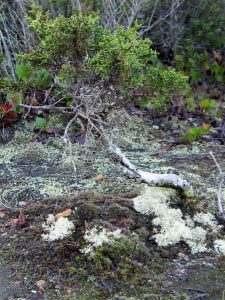
It’s only very recently that proposed development projects even had to look at vegetation, Teresa explains. “During the Mendocino cypress vegetation blitz from 2014–2019, we collected data for new classification. The results of that work astounded me. I saw vegetation patterns illuminated in a new way, even though I’ve lived here for decades. That’s why vegetation science works! I now have a better understanding of the biodiversity of this area and the patterns of vegetation.” CNPS chapter-based vegetation work, including contributions from DKY and others, feeds directly into a statewide effort to collect data at a regional level, in this case leading to a wall-to-wall vegetation map of the North Coast ecoregion, currently funded by the California Department of Fish and Wildlife.
In 2014, Teresa started a volunteer crew to conduct vegetation mapping. She continues to go out in the long field season with a lean crew. Over the years she’s trained countless volunteers, as well as CNPS interns.
Also the author of the new Lupines of California, will Teresa slow down anytime soon? Not likely—now that she’s retired, Teresa wants to spend even more time in the field with her volunteers and her dog Lupin. “I am such a proponent for vegetation classification. I was used to looking at plant classifications, but vegetation mapping is really hard work, and it’s much more exciting to spend time in the field. “It’s nice to be a botanist and collect data that can be used in conservation for the future” she concludes. “We can’t do conservation unless we know what we’re conserving.”
It’s nice to be a botanist and collect data that can be used in conservation for the future”
