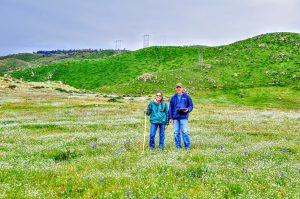
Ellen and Brian Cypher spent their careers studying California endangered species: Ellen as a plant ecologist and Brian researching the San Joaquin kit fox. After decades living in Bakersfield and working with California State University, Stanislaus, they’re enjoying the ocean and the redwoods near their new home in McKinleyville.
CNPS is great at disseminating information to professionals and the public, like native plant conferences, books and the journal Artemisia. We want to see CNPS continue that important work.
How did you first get excited about plants?
Ellen: I grew up in upstate New York, far from the nearest town. I wandered around the woods to entertain myself. I wanted to learn the names of the trees and flowers, so I got myself a Peterson Field Guide and learned the common names.
Brian: I was more of a suburban child but always very interested in animals and nature. Honestly, the plants were something I mostly just wandered through until I got to college. I was working on my degree in wildlife ecology at the SUNY College of Environmental Science and Forestry and realized that plants are a huge component of wildlife habitat, so I’d better know something about them. Ellen and I met there and later both earned our Ph.D. degrees at Southern Illinois University. I was studying coyotes, and Ellen the rare plant, cleft phlox (Phlox bifida). I had an opportunity to work on an endangered San Joaquin kit fox project, so we moved to California.
Ellen, was it through your work that you connected with CNPS?
Ellen: I was involved with the Illinois Native Plant Society when we were there. At that time, I traveled to California for the very first CNPS Conference. It definitely got me fired up. So when we moved to California, I got involved with the CNPS Kern Chapter and served as its president, among other offices.
Brian: I mostly attended the meetings and ate cookies.
What were some of your plant explorations?
Ellen: For a couple of decades, we were on a mission to visit every giant sequoia grove known in California. We got to about two-thirds of them and then realized there’s a really good reason why there aren’t trails to the rest — the habitats are just too steep. We’d also get out to places like Wind Wolves Preserve and Mount Pinos in the Los Padres National Forest.
Brian: In the springtime we like to visit Carrizo Plain National Monument. I did quite a bit of work there on kit foxes and kangaroo rats.
You moved to Humboldt County last year. What do you like about living there?
Brian: Our house is about a mile from the ocean. In 10 minutes we can be at the dog-friendly beach, and 10 minutes the other direction we’re in the redwoods. You can’t beat that. It’s a nice community up here — more environmentally conscious — and there’s always so much to do.
Ellen: We knew we wanted to retire somewhere near a university but with cooler weather. We had an extensive native plant garden in Bakersfield. At our new home the yard is a blank slate. We bought some plants at the CNPS North Coast Chapter plant sale in the fall: coast buckwheat, California aster, western columbine, Oregon grape, trillium, and redwood sorrel.
What’s the impact you hope to have from including CNPS in your estate plan?
Ellen: Brian and I dedicated our careers to conservation and recovery of endangered species, and we support organizations that further that mission.
Brian: CNPS is great at disseminating information to professionals and the public, like native plant conferences, books and the journal Artemisia. We want to see CNPS continue that important work.