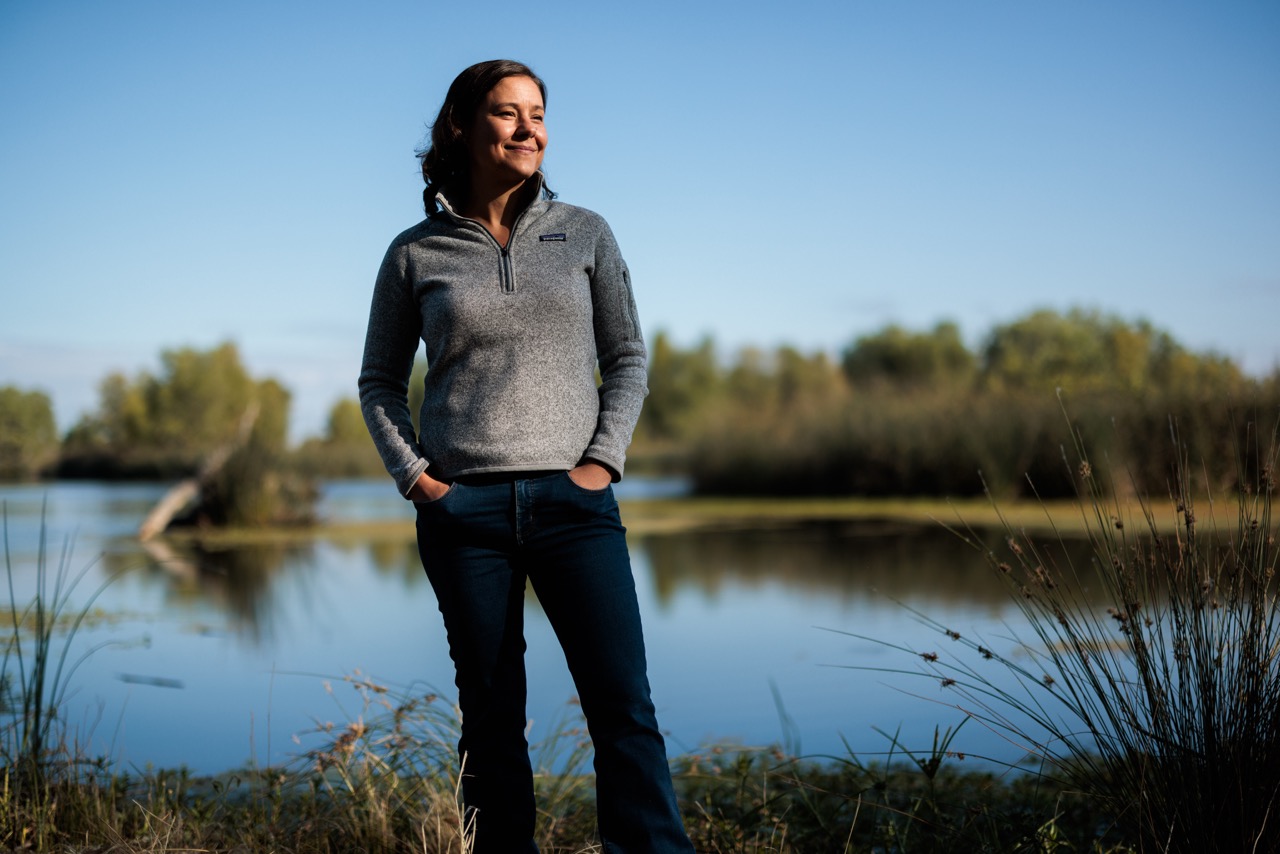
In 2018, Isabelle Duvivier, an architect and expert in sustainable urban design, moved to a street in Venice with no trees on it. For a lifelong native plant enthusiast and member of the CNPS Los Angeles/Santa Monica Mountains Chapter, this was an untenable situation. So, she says, “I started figuring out how to get trees planted in our community.” Duvivier knew that Noël Johnston, who was a neighborhood councilmember at the time, shared her interest in native plants. The two paired up to form a tree-planting working group. After placing trees on Duvivier’s street, they decided to keep going, collaborating with the city to install native plants at the local Mar Vista Gardens housing project. They called their new project the Verdant Venice Group (VVG).
Duvivier immediately started recruiting friends, neighbors, and even strangers to volunteer. When Venice real estate agent Janin Paine stepped outside one morning to find a friend walking down her street with Duvivier, a partnership was born. “Isabelle just looked at me and said, ‘You need some trees in front of your house.’ ” fondly recalls Paine, a member of CNPS’s San Luis Obispo Chapter, who became fast friends with Duvivier and eventually joined VVG as its volunteer director of marketing and development.

Since that day, Duvivier and Paine have collaborated with a growing roster of volunteers to plant native species throughout the neighborhood they love. Duvivier says she has always been a “native plant person,” an interest that began when she took a botany class at a local college, where students took group trips into the Santa Monica Mountains to create native plant books. She says it’s important to bring native plants out of the limited spaces of nature preserves and back onto city streets across Venice and beyond.
In their work with VVG, Duvivier and Paine have surrounded un-air-conditioned housing projects with shade-providing trees like coast live oak (Quercus agrifolia) and California bay laurel (Umbellularia californica). They have restored dunes along Venice’s iconic Ocean Front Walk, removing invasive grasses and planting erosion-fighting species like dune primrose (Oenothera deltoides) and yellow sand verbena (Abrona latifolia) along the famous pathways where roller skaters dance to ’90s hip-hop and tourists snap pictures of palm trees by the beach. They have transformed the streets surrounding the original Gold’s Gym with plants like dark star ceanothus (Ceanothus ‘Dark Star’) and California goldenrod (Solidago velutina ssp. californica), also planting gardens in two schools and four parks. Flora joined the Verdant Venice Group on one of their regular weekend workdays as they teamed up to transform the landscape, like their mission statement puts it, “one tree at a time.”

Above, regular VVG volunteer Cecilia Sebastian (left) and her cousins Alfred Hernandez (second from left) and Sebastian Hernandez (right) help fellow volunteer Ian McIlvaine with planting a coast live oak (Quercus agrifolia). Cecilia, who was one of Duvivier’s many neighbors present at the planting, says she comes every weekend with her cousins. “I didn’t know anything about native plants before I met Isabelle,” Cecilia says. “But now it’s my favorite part of the week. It’s like a little ritual—my cousins come to my house for a sleepover and then we get in the garden together and get our hands dirty.” At right, Alfred Hernandez adds mulch to a newly planted fiesta marigold monkey flower (Diplacus ‘Fiesta Marigold’), red-flowered buckwheat (Eriogonum grande var. rubescens), and coast live oak seedling.

Venice Beach Business Improvement District representatives Tracy Roybal (left) and Eswien Faena (center) prepare to sheet mulch a newly planted California buckeye (Aesculus californica) as volunteer Diane Greenseid looks on. Faena says that VVG’s work makes the bustling Venice streets more inviting, supporting the local merchants and storefronts he represents.

Coastal California poppy (Eschscholzia californica var. maritima) on the Penmar Golf Course provide essential shelter for native pollinators. At night, when the petals of the poppies close, male “bachelor bees” seek shelter from the elements and predation inside a makeshift golden sleeping bag. They wake with the sun to forage—and pollinate—once more.

As the dog park workday drew to a close, Paine’s boyfriend Luis Gaona, a member of the Yaqui Nation, led the group in a ceremony to bless the new plantings. The assembled volunteers gathered around a newly planted coast live oak (Quercus agrifolia) and, at left, California buckeye (Aesculus californica) as Gaona provided handfuls of masa (or cornmeal) to toss onto the mulch. He explained that the masa would serve as a sacred offering of blessing, protection, and reciprocity, a prayer that the tree and their community would thrive. “We are all seeds that sprout into trees,” Gaona says. “And today, we ask for the Creator’s blessing, for the seeds, and for ourselves.”

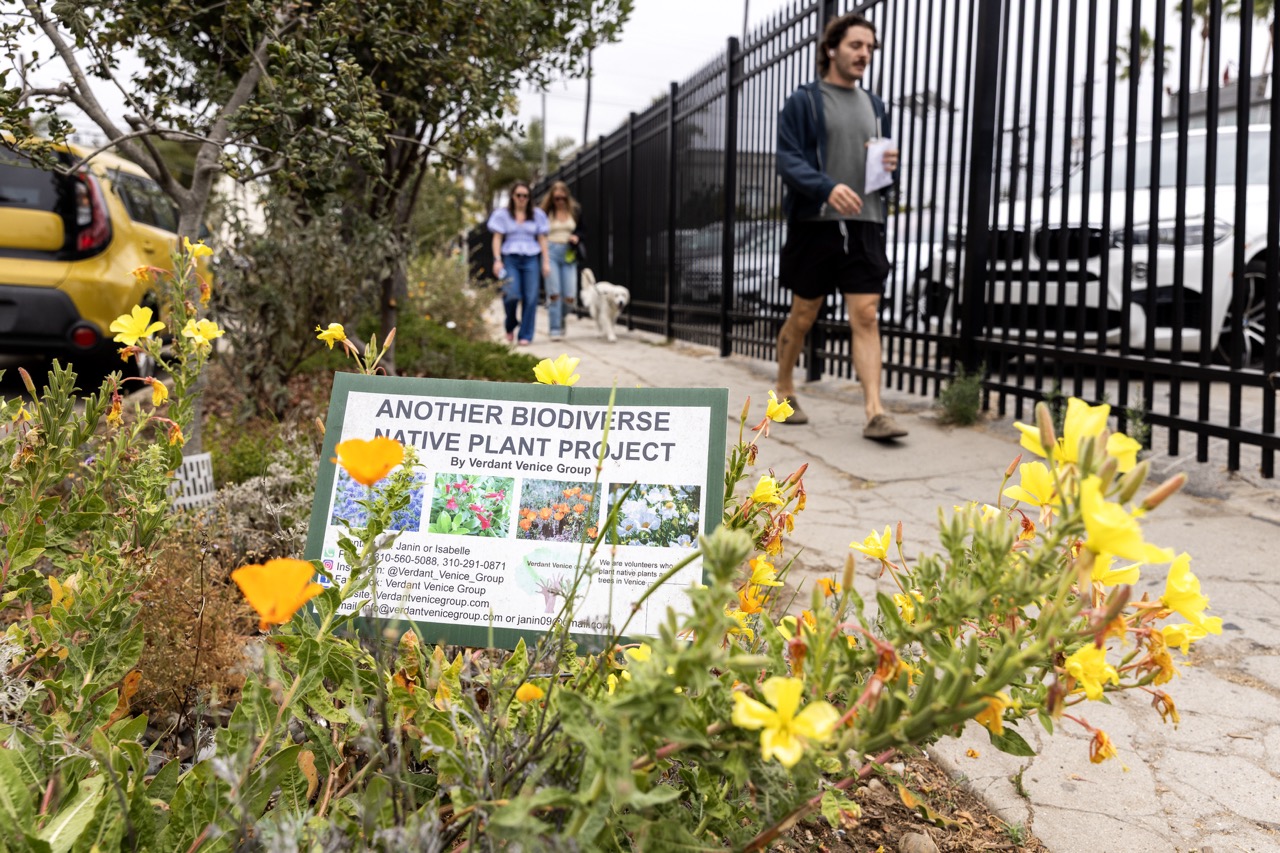
Elegant clarkia (Clarkia unguiculata) and Hooker’s evening primrose (Oenothera elata ssp. hookeri), both pictured above right, thrive alongside toyon (Heteromeles arbutifolia) and coast live oak (Quercus agrifolia) in the narrow bed next to a wall on Sunset Avenue. The road verge features mugwort (Artemisia douglasiana), creek monkeyflower (Erythranthe guttata), common rush (Juncus patens), and yerba mansa (Anemopsis californica). Duvivier says that the team at VVG is currently focused on mastering the art of passive watering; the beds here, for example, are irrigated by groundwater pumped out of a nearby parking garage twice a day. “Planting trees is easy to do,” she says. “The hard part is actually getting the trees cared for and watered.” Fortunately, Venice is uniquely positioned at the bottom of the watershed, capturing stormwater that flows down through the city to the sea. Duvivier says that expanding the signature VVG approach to include these greater environmental factors will be key to the organization’s ongoing evolution.

On the west side of Third Avenue—behind the original Gold’s Gym location, where Duvivier and Paine both train—California poppies (Eschscholzia californica), Hooker’s evening primrose (Oenothera elata), and globe gilia (Gilia capitata) bloom from a few inches of soil between the sidewalk and a wall.

Across the street, the VVG leaders pointed out a tree whose leaves had been completely denuded by mourning cloak caterpillars. “We’re very conscious about pollinators and which plants attract them,” Paine adds. “We don’t often plant willows because they need water, but we planted one here because it was always a very wet spot and it was just covered in caterpillars. They devoured it!” This whole-biome strategy influences their approach throughout Venice, prompting creative solutions to fit native plants anywhere and everywhere they can.