Spring 2025
By Emily Beyda
Photos courtesy of Krystle Hickman
The discovery that inspired photographer Krystle Hickman’s new book The ABCs of California’s Native Bees arrived in the form of a chance encounter. In 2018, Hickman was shooting photos at the Sepulveda Basin Wildlife Reserve in Van Nuys—a key volunteering site for the CNPS L.A./Santa Monica Mountains Chapter—when a bee showed up on a branch of invasive mustard flower. She snapped an image and shared it with her beekeeper contacts, who had no idea what the creature could be. Hickman turned to a Facebook group of entomologists, who ID’ed her find as an andrena, one of the largest and most species-diverse of California’s native bees.

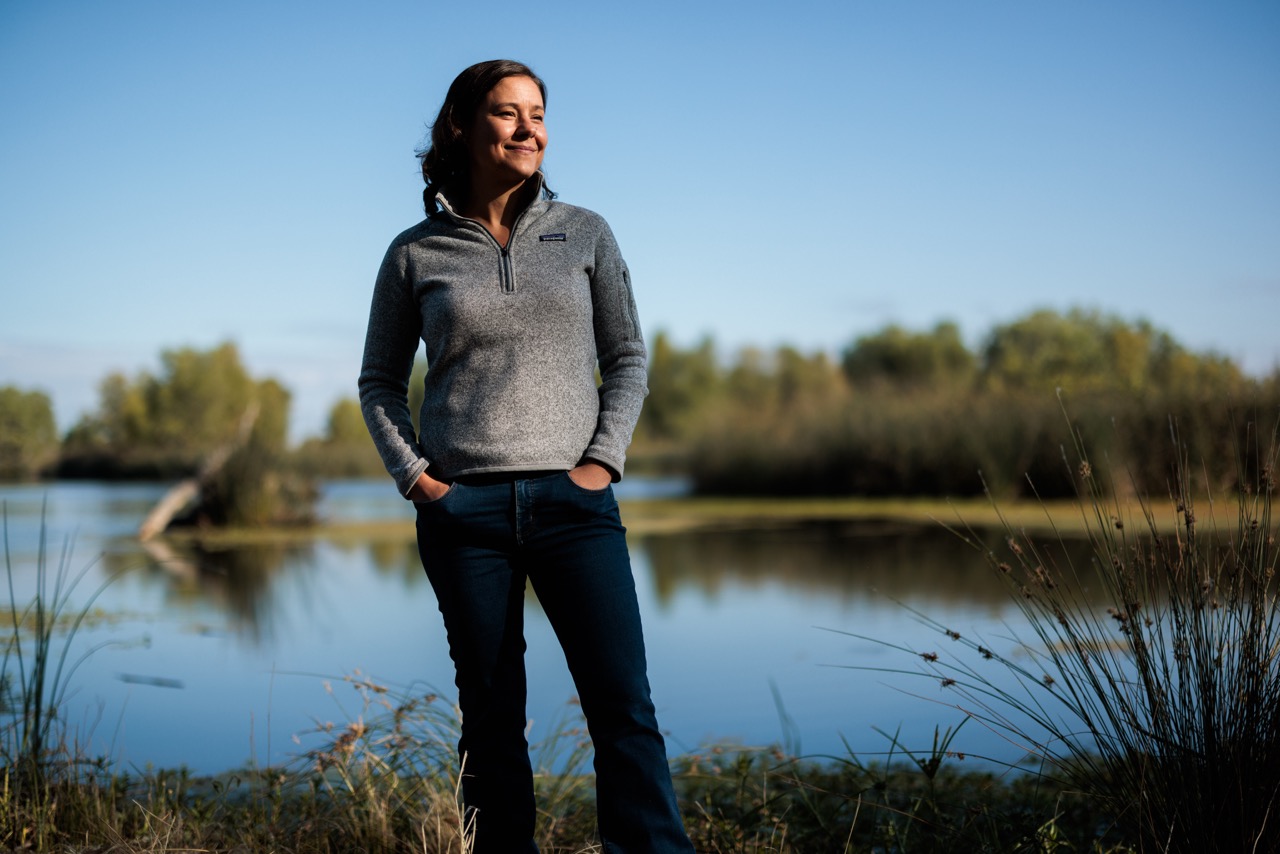
Krystle Hickman pictured at Arlington Garden in Pasadena in November 2025. (Portrait by Alisha Jucevic)
“It really expanded my world,” Hickman says. “The honeybees were my gateway bee, and then native bees were my gateway to the entire ecosystem. Literally, I don’t even know if I’d actually heard the term ‘native plant’ before.”
Following the bees as they explored the California landscape opened Hickman’s eyes to the beauty and centrality of native plants in the wellbeing of the ecosystem as a whole. As her project continued, Hickman photographed a unique species of bee for every letter of the alphabet, from Melissodes agilis (the agile longhorn bee) to Calliopsis zonalis (the zone-tailed banded-mining bee). Eventually, she got the idea of turning her series into a book. Accompanied by landscape photography and Hickman’s thoughtful essays, The ABCs of California’s Native Bees traces her journey from Anza-Borrego Desert State Park to the Trinity Alps, traveling the length and breadth of the state while exploring the home territories of many of California’s native bees.
Curiosity is one of Hickman’s defining traits, propelling her to create a successful career documenting the natural world. When Hickman taught herself to take photographs back in 2016, she had no idea that native bees even existed. Today, in addition to her photography, Hickman works as a community scientist and native bee educator, and she has given a TEDx talk about art and self-discovery. As a National Geographic Explorer, Hickman has received grants from the National Geographic Society to raise awareness about the decline of native bee species.

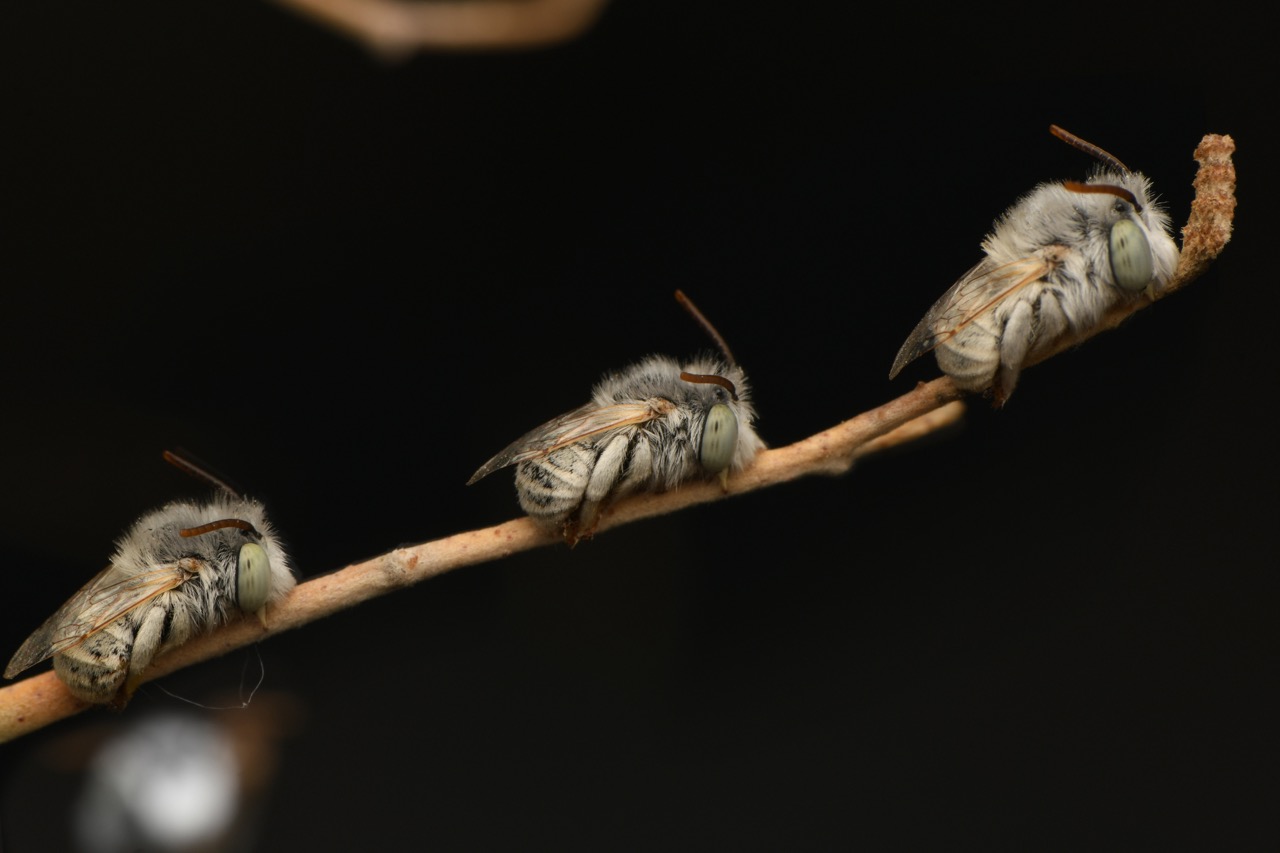
Clockwise from left: Two female Riverside cuckoo bees (Holcopasites ruthae) sleeping on bromes (Bromus spp.) Male agile longhorn bees (Melissodes agilis) sleeping on flax (Linum spp.). A male California poppy fairy bee (Perdita interrupta) on a California poppy (Eschscholzia californica) in the recently regrown native yard of a house lost in the Eaton Fire.
In 2022, Hickman gave a native bee presentation at the CNPS Conference in San Jose—a wildly popular talk that she later adapted for presenting to individual CNPS chapters.
According to Hickman, California is the natural habitat to 8% of all of the bee species in the world, with 1,643 species out of 20,000 native to her home state—truly a staggering wealth of native pollinators. When she stumbled onto her “gateway bee,” as she calls it, Hickman didn’t realize how different honey and native bees really were. Non-native honeybees are social hive dwellers that were first brought over from Europe in the 1600s, with a generalist approach to pollination that makes them valuable in commercial agriculture. Ninety percent of native bees are solitary, and many are regionally specific, highly efficient pollinators that are vital in helping native plants reproduce and local ecosystems thrive.
With native bees’ wildly different habits and habitats, Hickman initially had difficulty finding the species she wanted to photograph when looking in places known to host honeybees. A breakthrough came when she saw an Instagram post from Crescent Farm, a water-saving demonstration garden at the Los Angeles County Arboretum and Botanic Garden that uses a large number of native plants. Horticulturist John Latsko had snapped a picture of Melissodes agilis (the aforementioned agile longhorn bee) perched on a flower petal. “After visiting the garden and seeing the native plants, that’s when I made the connection,” Hickman says. “If you want to find native bees, you have to look for native plants.”
Bees evolved to the plants that they have relationships with. “And 20% to 45% of them are specialist pollinators,” Hickman adds, “which means they only collect pollen from a certain plant.” In California, native plants like phacelia and poppies are critical to the health and wellbeing of pollinators, who rely on them for food. Since most native bees aren’t social hive builders, male bees even use native plants as shelter, sleeping protected by petals or perched on stems.
Hickman tapped into this connection to find the bees she wanted to photograph, tracking native plants on the app iNaturalist and using their natural rhythms of bud and bloom to plan her bee photographing excursions. She would wait until users posted a plant that looked like it was either flowering or just about to bloom, then show up right when bee behaviorists anticipated the specific species she was looking for would be visiting the plants, driving four or five hours in the early mornings so she could be present when the bees arrived. The strategy was remarkably successful.
Hickman says she tried to share that experience of discovery with readers of The ABCs of California’s Native Bees, inspiring them to bring fresh eyes to their familiar surroundings. Just as Hickman stumbled upon her first native bee on an unexpected backdrop of a mustard flower, the book invites readers to open their eyes to the mysteries and possibilities of their everyday environments. “I want people to realize that nature doesn’t have to be a place you can travel to,” she says. “You can be in your own backyard.”