Winter 2025
By Stu VanAirsdale
At first glance, the plant known as the Jurupa oak doesn’t look like California’s oldest living tree. It barely even looks like a tree.
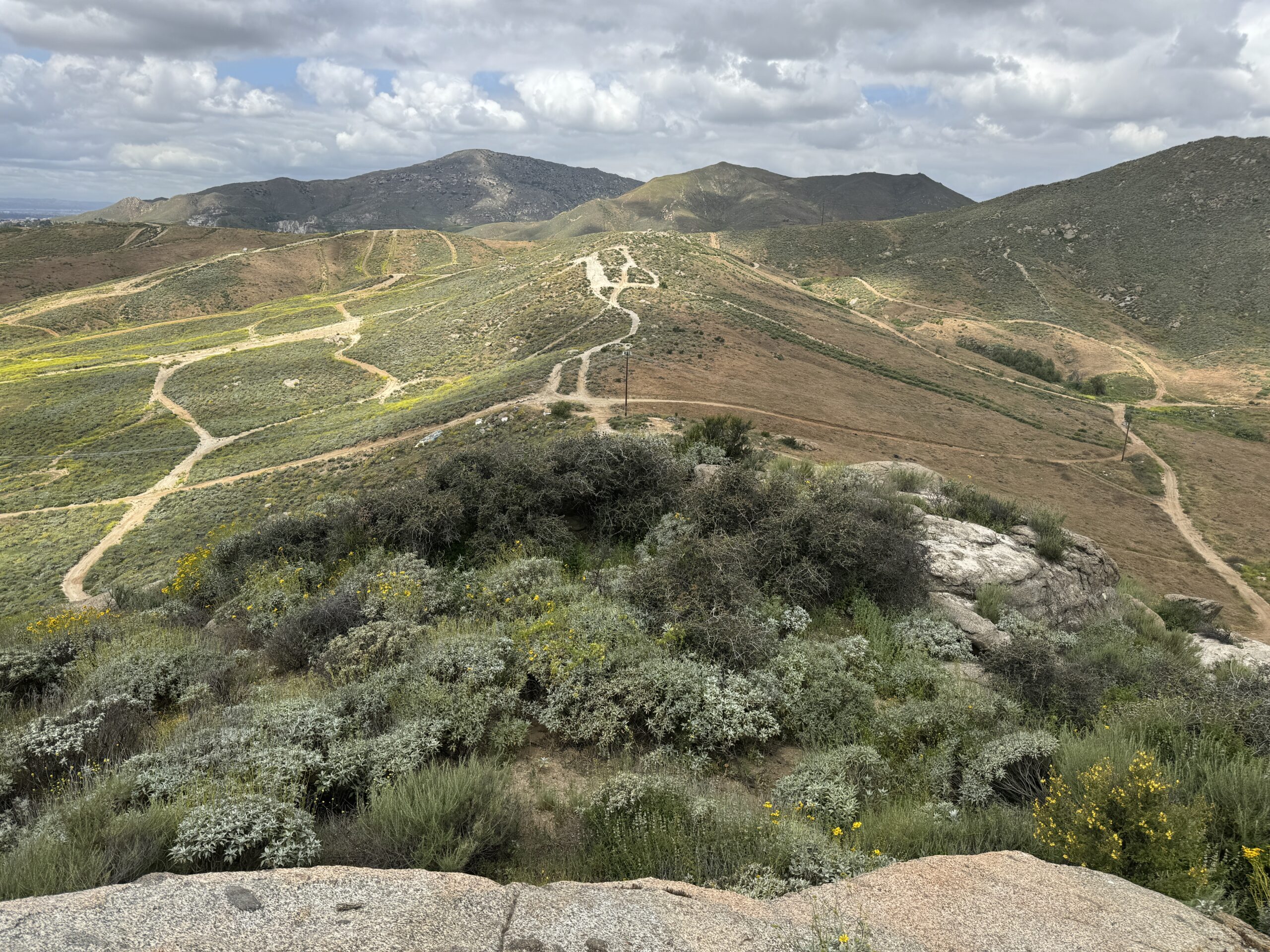
Ensconced on a granite hillside overlooking the Riverside County town of Jurupa Valley, the oak’s gnarled tangle of branches and leaves sprawls roughly 82 feet by 26 feet. It rises on stubby trunks barely a yard above the ground—shorter in some spots than the saber-toothed cats and mastodons that likely looked on the tree before going extinct over 10,000 years ago. As the only known occurrence of Palmer’s oak (Quercus palmeri) remaining in the entire 1,700-square mile Santa Ana River Watershed, it is arguably the state’s ultimate survivor: It has withstood the end of an ice age, countless fires, a rocky habitat hotter and drier than oaks are usually known to handle, and a generation of bemused researchers whose close examinations estimate the tree’s age between 13,000 and perhaps even 18,000 years old.
Now, millennia after ground sloths inched past the oak into oblivion, a new set of forces has put the Jurupa Oak’s own future in question.
Last September, city leaders in Jurupa Valley voted 3-2 to approve the Rio Vista Specific Plan, which proposes developing 400 acres around the Jurupa Oak with residential and light industrial development. The plan requires a 450-foot buffer around the oak, a potentially insufficient distance to protect the oldest known living plant in California and the oldest known oak on Earth. The plan’s approval has prompted the California Native Plant Society to join a suit filed with the Center for Biological Diversity, Endangered Habitats League, and Friends of Riverside’s Hills for violations of the California Environmental Quality Act (CEQA). By overlooking threats to the Jurupa Oak’s watershed and failing to share key studies for public review and adequate comment, the suit alleges, the city’s actions undermine an essential process meant to help communities like Jurupa Valley avoid irreparable harm to unique—and uniquely historic—vegetation like the Jurupa Oak.
Supporters of the suit argue that while the buffer in the current plan may reflect a good-faith conservation effort by its proponents, the plan inadequately accounts for serious risks to the tree. “I don’t think that anyone involved wants to see this tree go away,” says Brendan Wilce, conservation program coordinator for CNPS. “They just really do feel that this project isn’t going to impact the oak. And there’s a chance that it wouldn’t—that this project could go forward and there wouldn’t be any detrimental impacts. But the unknowns are the real concern.”
Palmer’s oak populations were once more widely spread in California. Its range has been restricted to cooler, higher elevations with more precipitation as habitats have warmed since the last ice age. Some experts hypothesize that the Jurupa Oak has managed to persist in its more arid climate due to a perched water table that collects rainwater to support the oak.

A trunk and foliage belonging to the Jurupa Oak. (Photo credit: Aaron Echols)
But ecologist Aaron Echols, a CNPS member, points out that the presence of such a water repository inside a solid granite slab—like the one the Jurupa Oak inhabits—seems unlikely. He cites water runoff from the areas above the oak that potentially keep it fed, adding that construction grading and associated development could alter the flow of water to the tree. “In a really bad five-year drought—like the one California went through from 2012-17—that soil profile would surely have dried up,” Echols says. “There’s got to be something else there.”
CNPS joined its co-plaintiffs and others in submitting a letter of concern to the City Council before its vote last September. The letter urged the city to set aside 100 acres of the planned light industrial and business park development as a preserve around the Jurupa Oak. Echols notes that such a preserve—vastly expanding the 450-foot buffer established in the official plan—would protect the oak’s immediate watershed. “If there is an aquifer that’s a factor here, that water would hopefully be able to seep into the ground [around the oak] and replenish it,” Echols says.
Moreover, the granite bedrock and rocky ridge immediately adjacent to the oak will require explosive blasting to grade and prepare the area for construction. The lawsuit seeks an environmental review to assess how such invasive measures may potentially damage the oak’s root system—a subterranean thicket that originated when mammoths roamed the earth and may extend well beyond the buffer zone. Other Palmer’s oaks in California have estimated root systems of roughly 30 feet at a mere 200 years old. While the physiological comparison is hardly apples to apples—or oaks to oaks—the Jurupa Oak is at least 65 times older than that. Only a thorough review can help determine if it has correspondingly complex roots to match.
The effort to conserve the Jurupa Oak and its surroundings may extend through or even beyond 2025, as the CEQA process unfolds—the latest chapter in a long saga of resiliency and renewal. “People don’t have to go up there and see the oak and touch it in order to experience it,” Echols says. “I think just knowing that it’s there—knowing that its environment is intact—there’s value there.”