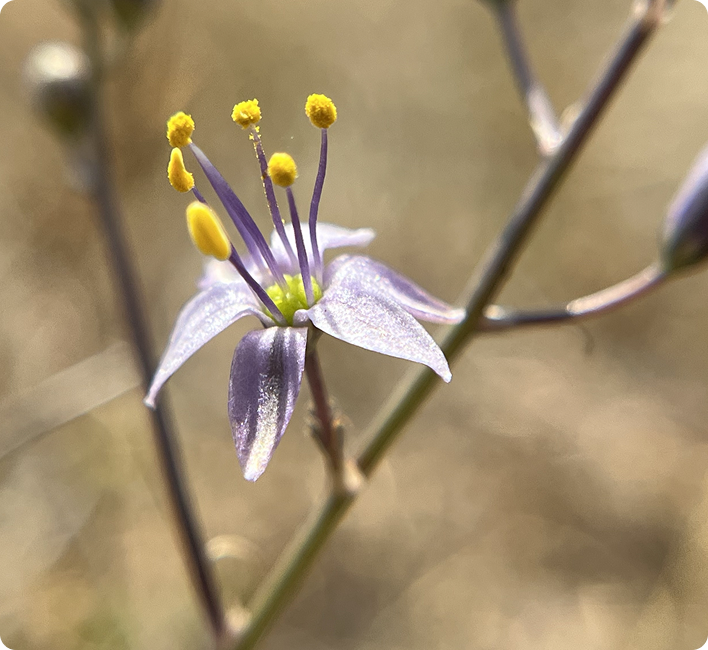
Extinction is on the rise worldwide, but California is pushing back. California’s botanical institutions are determined to prevent any further extinction of the state’s native plants.
Share to
Facebook
X
LinkedIn
Email
Threads
BY CHRISTA HORN AND EVAN MEYER
Extinction is on the rise worldwide, but California is pushing back. Out of more than 6,000 native plant taxa, only 22 are presumed extinct — and California’s botanical institutions are determined to prevent any further extinction of the state’s native plants.
CaPR members Heather Schneider (Santa Barbara Botanic Garden) and Brett Hall (UC Santa Cruz) worked together to organize a day surveying for coast wallflower (Erysimum ammophilum) in the Big Sur area. Photo: Sarah Termondt
In 2014, California’s native plant leaders came together to form the California Plant Rescue (CaPR) under the auspices of the Center for Plant Conservation, a national organization providing guidelines and support for native plant species survival. The goal: collect and conserve the seeds of 75 percent of plants ranked rare, threatened, or endangered (CNPS Rare Plant Rank 1B) in the California Floristic Province by 2020. The 75 percent by 2020 target is one of 16 plant conservation targets set by the United Nations Convention on Biological Diversity.
CNPS staff and volunteers collected seeds from the rare Sulphur Creek brodiaea (Brodiaea matsonii), at one of the only two sites where the species is known to occur in the world. Photo: Aaron E. Sims
Thanks to the work of professionals and citizen scientists, the group is well on its way toward reaching its target, with more than 50 percent of 1B species now in collections. These collections preserve high levels of genetic diversity in botanic gardens and seed banks to safeguard populations against extinction. As progress advances, so too does support. California’s new Biodiversity Initiative, the statewide directive to preserve and protect biodiversity in the face of climate change, calls for increased funding to support the very efforts CaPR has well underway.
Efforts in action
The CaPR collaborating institutions partner with land managers, funders, and other organizations to complete their collections. They also gather data about wild populations, providing baseline information for future generations. The collected seeds become the focal point of integrated plant conservation strategies, connecting collections, horticultural practices, and species-specific research for plant conservation.
CaPR members often work with partners in various tasks. Here California Department of Fish and Wildlife vegetation crew members Catherine Curley and Todd Keeler-Wolf discuss the nature of an isolated wetland stand in the Modoc Plateau region. Photo: Brett Hall
CaPR members collect and store seeds as an irreplaceable insurance policy against loss in the wild, ensuring our plants never go extinct. The seeds we collect provide the raw materials for population enhancement, restoration, and recovery, as well as opportunities for research. A seed has power. As ethnobotanist Gary Paul Nabhan has said, “It contains a life spark that allows the regenerative process to happen. We need seeds because they are the physical manifestation of that concept that we call hope.”
CaPR’s collaborative spirit has allowed the group to set ambitious goals, involving hundreds of people across the state. This photo essay documents the day-to-day life of CaPR over the past three years, through the different stages of seed collection, processing, and conservation work. From monitoring populations to preparing seeds to add to our seed banks, these activities feature some of California’s most beautiful plants and places.
In 2018, San Diego Zoo Global launched a new program to collect seeds of California rare plants south of the US-Mexican border. The efforts are focused on plants that are rare in both countries, including dehesa beargrass (Nolina interrata), known from a single population in Baja California, and a handful of occurrences in San Diego County. The binational team includes representatives from the CNPS Baja California Chapter, the Center for Scientific Research and Higher Learning of Ensenada (CICESE), and San Diego Zoo Global’s Plant Conservation team. Photo: Sula Vanderplank
To learn more about CaPR and see a list of all CaPR participating organizations, please visit www.caplantrescue.org
Christa Horn and Evan Meyer are members of the CaPR team. Christa is a Plant Conservation Program Specialist for the San Diego Zoo Institute for Conservation Research. Evan is Assistant Director of the Mildred E. Mathias Botanical Garden at the University of California Los Angeles.
Rancho Santa Ana Botanical Garden’s senior field botanist, Duncan Bell, hikes to the top of southern California’s highest peak, Mount San Gorgonio, to make a seed collection of the newly described Krantz’s catchfly (Silene kranztii). Photo: Cheryl Birker
Beach layia (Layia camosa) is a state and federally endangered annual wildflower threatened by coastal development, invasive plants, and foot and vehicle traffic. In 2017, the Santa Barbara Botanic Garden partnered with ManTech SRS Technologies, Inc. to survey and map beach layia at Vandenberg Air Force Base. This effort resulted in updated sub-meter accuracy maps for the extent
and abundance of beach layia across the base, as well as the procurement of conservation seed collections. Photo: Heather Schneider
California Department of Fish and Wildlife botanist Merissa Hanisko reaches for the sky as she collects seeds of Castle Crags ivesia (Ivesia longibracteata), pictured here, a plant only known from the rock crevices of Castle Crags in Shasta County. Merissa and two additional volunteers joined a CNPS staff botanist to collect the seeds of this species along with Castle Crags harebell (Campanula shetleri), another rare species known only from the vicinity of the Crags. Photos: Aaron E. Sims
Castle Crags Ivesia (Ivesia longibracteata) Photo: Aaron E. Sims
CDFW Merissa collected the diminutive seeds of Castle Crags harebell (Campanula shetleri) Photo: Aaron E. Sims
Castle Crags harebell (Campanula shetleri) Photo: Aaron Sims
A giant mountain dandelion (Agoseris grandiflora) with seeds fit to collect, found in the Santa Cruz Mountains. Photo: Brett Hall
Common species are also an important element of CaPR’s mission. Here Stacy Anderson collects California poppy
(Eschscholzia californica) seed from plants tucked into a sea of invasive grasses in a protected area. Photo: Katie Heineman
Mexican collaborators collect seeds of multiple rare plants in one of the largest vernal pools in the California Floristic Province, in Baja California (Mexico). Photo: Sula Vanderplank
The binational team collects seeds of the barberry-leaf goldenbush
(Hazardia berberidis) on the dunes of Reserva Natural Punta Mazo in San Quintín, Baja California, Mexico. Photo: Sula Vanderplank
In summer 2018, a group of conservation corps members working with BLM assisted the UC Santa Cruz Arboretum to collect several rare species for long-term seed banking, including Pine Hill ceanothus (Ceanothus roderickii), Stebbins’ false bindweed (Calystegia stebbinsii), Red Hills soap plant (Chlorogalum grandiflorum), El Dorado County mule’s ears (Wyethia reticulata), and Layne’s ragwort (Packera layneae). Photo: Brett Hall
Joe Davitt gently removes seed from the dried remnants of spreading navarretia (Navarretia fossalis), a threatened vernal pool species. Photo: Stacy Anderson
The Santa Barbara Botanic Garden is a regional hub for seeds collected on the Channel Islands, like this soft-leaved indian paintbrush (Castilleja mollis), which is also listed as federally endangered. Photo: Christine Pang
CaPR’s rare plant seed collections are curated along guidelines established by the Center for Plant Conservation, including dividing the seed put into long-term storage between multiple banks for safety. After carefully cleaning the seed of the rare San Diego button celery (Eryngium aristulatum var. parishii), Tobin Weatherson divides the seed from each mother plant in two for long-term storage at San Diego Zoo Global’s seed bank and a backup with the National Laboratory for Genetic Resource Preservation in Fort Collins, Colorado. Photo: Joyce Maschinski
Enjoying Flora?
Join CNPS today to receive Flora magazine in print, among other terrific member benefits.
Gardening with native plants brings biodiversity to your garden. But there is even more you can do—follow these 7 steps to make your garden a biodiversity powerhouse!