Spring 2025
By Stu VanAirsdale
Photographs by Alisha Jucevic
The official designation of Chuckwalla and Sáttítla Highlands national monuments in January honors the deep connection between people and nature in California. But that’s not all. The monuments enrich local economies, support outdoor recreation, honor Tribal sovereignty, and give people a place to create lasting memories with family and friends. For all these reasons, the decades-long campaigns to protect Chuckwalla and Sáttítla Highlands united a broad swath of supporters across generations—from members of local Tribes to key business figures, from scientists to veterans, from councilmembers to senators (and every type of local, state, and federal official in between).
Recently, Flora visited the desert to hear from some of the Chuckwalla campaign’s most indelible voices about what the landscape means to them—and what the new monument can mean to all of us. Together, their perspectives and motivations represent a growing, multifaceted movement on behalf of public lands across California.

The Tribal Leader
Thomas Tortez Jr.
Former Tribal Chairman, Torres Martinez Desert Cahuilla Indians
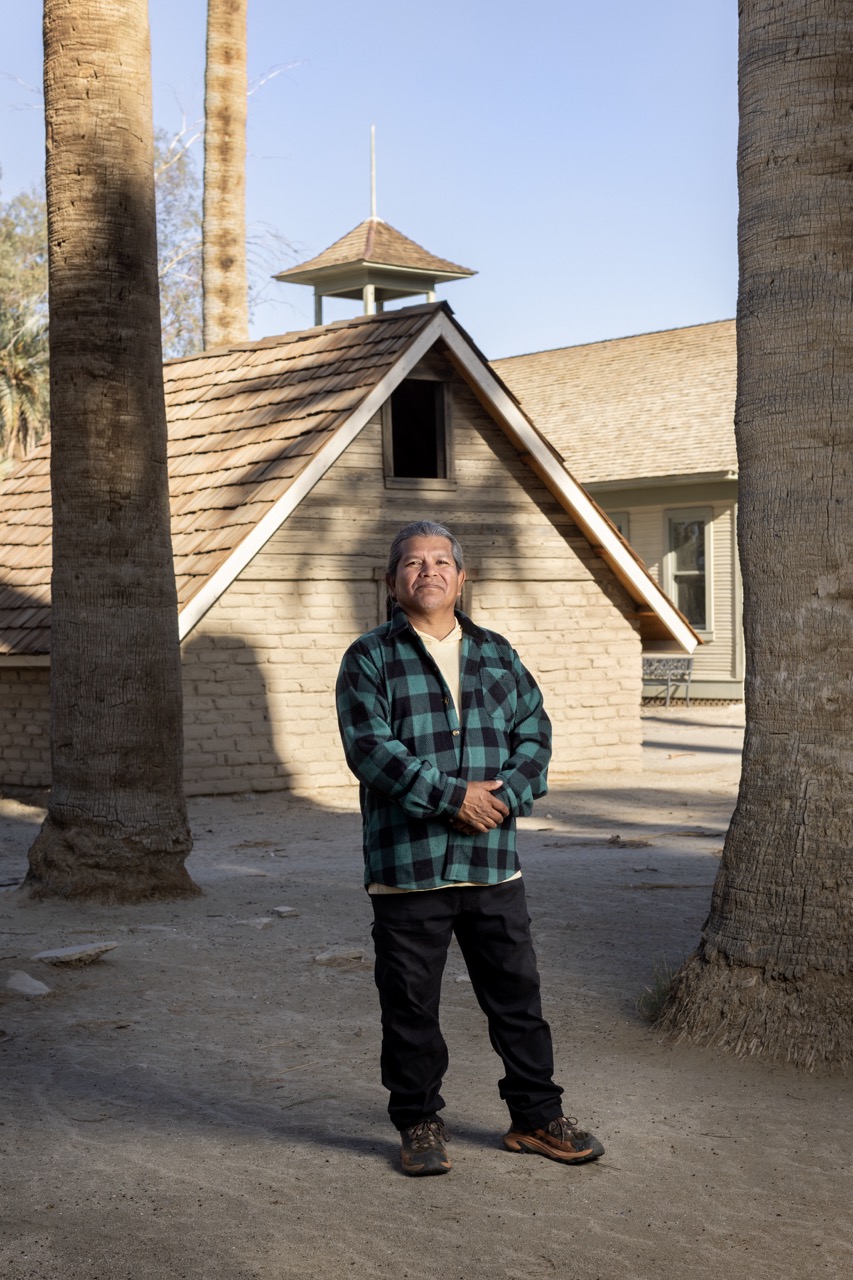
Former chairman Thomas Tortez Jr. of the Torres Martinez Desert Cahuilla Tribe is pictured on the reservation near Thermal, Calif., on Saturday, March 8, 2025.
Thomas Tortez Jr. remembers the sound of the wind. As an 8-year-old on his first visit to the Chuckwalla Mountains, the breeze rustled and whipped around him while he listened to his father tell the creation story of their People. Years later, as the Chairman of the Torres Martinez Desert Cahuilla Indian Tribe, he would tell the same story to Interior Secretary Deb Haaland and Rep. Raúl Ruiz while accompanying them on a visit to Chuckwalla’s mythical Painted Canyon.
“I said this is a spot we keep sacred, because we believe that when our people pass away, they go through this canyon on their journey,” Tortez recalls. “I said, ‘If you listen, sometimes you can hear the movement.’” Just then, under the hot, still valley sun, a gust of cooling wind whistled around their group. Recalling a lifetime of moments like these, Tortez shakes his head and smiles. “It is a spiritual place,” he says.
Tortez’s time as chairman culminated in another remarkable memory last January, when he stood by Joe Biden’s side at the White House as the former president signed the formal proclamation designating Chuckwalla National Monument.
“Me being there on the stage with the president—it’s an honor,” says Tortez, who received from Haaland one of Biden’s pens from the event. “I feel like I represented everyone who was there to help get this done. But the work has just begun.”
Biden’s proclamation invoked the Antiquities Act of 1906, a vital element of the Tribe’s push for co-stewardship of the land their ancestors called home for centuries on their long migration south. With the co-stewardship arrangement, Tortez anticipates new opportunities to educate Chuckwalla visitors—from campers to researchers and everyone in between—about the sensitivities of the land and its significance to Indigenous Peoples. Additionally, he says, a new commission comprising the Torres Martinez Desert Cahuilla Indians and seven other area Tribes will mobilize to protect artifacts and burial grounds on the sites of former Tribal villages.
Protecting nature is essential, too, Tortez says, noting Chuckwalla’s vast range of wildlife and how resilient native plants like the honey mesquite (Nelutuma odorata) have sustained generations with food and medicine. Speaking of generations, these days Tortez takes his own son to the sacred sites to which his father introduced him as a boy. “For us, it’s a way of cleansing—going out there to meditate and cleanse and disconnect,” he says, a slight desert breeze picking up around him. “Clean your thoughts, cleanse your body, and partake in the environment, just like we used to do a long time ago.”

Clockwise from top left: Thick-leaf ground-cherry (Physalis crassifolia); a ladder hiker in Painted Canyon; giant Spanish needle (Palafoxia arida); honey mesquite (Nelutuma odorata)
The Youth Advocates
Brenda Ortiz and Rhian Reyes
Youth ambassador, Protect Chuckwalla Campaign organizer, Audubon California

Brenda Ortiz (R) and Rhian Reyes photographed at Chuckwalla National Monument on March 9, 2025.
Though they both hail from the Eastern Coachella Valley, Brenda Ortiz and Rhian Reyes had fundamentally different perspectives on the region while growing up. Ortiz, who loved the desert’s landscape and vibes, was an enthusiastic hiker and explorer of the mountains, canyons, and trails around Chuckwalla. Reyes, meanwhile, got lost on her first desert hike with friends as a 14-year-old and couldn’t wait to go to college in Seattle. (She returned mere weeks later, newly thrilled to be home.)
To say Ortiz and Reyes eventually found common ground is an understatement: In 2023, both women took on leadership roles in the campaign to establish Chuckwalla National Monument. Ortiz joined the Protect Chuckwalla coalition as its youth ambassador, focusing her efforts on rallying peers via social media, events, helping guide tours for news organizations, and even writing a Spanish-language op-ed in a local newspaper. Reyes joined the coalition in a similar capacity, even introducing Rep. Raul Ruiz to the public after her first speech at the Chuckwalla campaign launch event in September 2023.
For Ortiz and Reyes, their work on behalf of Chuckwalla reflected their mutual interests in social and environmental justice. “I don’t really know the name of plants, but I do know that the environment should be protected.” says Ortiz, 21, who will graduate from UC Irvine this spring with a double major in sociology and education sciences. “And I know that my community should have equitable access to the outdoors, and these are lands that deserve to be protected and deserve to be accessed by everybody.”
Reyes, 25, worked with local businesses and youth throughout the Eastern Valley to help them understand and advocate for protecting Chuckwalla. She recalls speaking at one high school where students were surprised to learn that natural splendor like the Chuckwalla Mountains was immediately accessible to them. “They had no idea you could hike,” she says. “They had no idea you could camp. Not a single student I talked to at that school had ever been hiking or camping before in their lives, let alone in this region that’s so beautiful and right in the backyards. That was really a stark contrast for me.”
The pair became friends over the months leading up to the monument’s formal designation in January, by which time Reyes had joined Audubon California as a full-time campaign organizer. The White House even invited Reyes to speak at the ceremony in January designating the monument.
Of course, there’s plenty more to accomplish for the Chuckwalla coalition. For their parts, Reyes and Ortiz are just getting started. “People are very passionate about Chuckwalla,” Ortiz says. “[The campaign] warmed my heart a lot, and it all just made me more excited to continue doing this work.”

The Congressmember
Dr. Raul Ruiz
Representative, CA-25

National monuments don’t materialize overnight, and they don’t emerge fully formed from the handiwork of one person. But it helps to have a few well-positioned champions in the right place at the right time to advance the cause. For Chuckwalla, that champion was Dr. Raul Ruiz.
Rep. Raul Ruiz (at right) speaks at an event urging the designation of national monuments and sacred lands in Washington, DC, on April 16, 2024. Behind Rep. Ruiz are California Sen. Alex Padilla (L) and Rep. John Garamendi (CA-8). (Photo credit: Paul Morigi/Getty Images)
Ruiz, a physician who joined Congress in 2013 (and who has represented the 25th Congressional District since 2023), made the establishment of a national monument at Chuckwalla a key priority of his first year in office. Conversations about the planned monument—an important cultural and economic prospect for his district—started with district stakeholders months before he introduced legislation for the monument in September 2023.
A broad, inclusive coalition of supporters soon took shape both in Washington and at home in California. “Our goal was to make this a bottom-up effort,” Ruiz says of the grassroots community leaders and youth advocates. “And this [campaign] could not have had such significance without the Tribal nations and their leadership, because this is beyond just protecting plants and animals. This is about protecting sacred sites and origin stories and people’s connections to their heritage, their ancestors, and to the land.”
Ruiz had his own deep connections to Chuckwalla. He goes to the site to fast, to pray, and to contemplate some of his life’s biggest choices. It’s where he decided whether or not he should propose to his wife (answer: yes) and where he should go to medical school. His twin daughters started climbing the ladder routes in Painted Canyon when they were 6. He knew that it was easy for area residents to overlook the natural wonder outside their doors, and that too often, families and young people sought recreational opportunities beyond the majesty and adventure of the desert. “A big part of this movement is to connect people to these opportunities—to inform them of these locations,” Ruiz says. “So they, too, regardless of income, can enjoy them. And another thing I like about the Chuckwalla National Monument is that it’s free.”
Working with the energy industry, Ruiz and other advocates achieved compromises that upheld existing energy agreements while setting aside over 620,000 acres of desert land from solar farms and mining. Less than 18 months after first introducing the idea of Chuckwalla National Monument to Congress, Ruiz looked on at the White House as the monument was made official.
He pauses when asked what the protection of Chuckwalla means to him, an emotional silence giving way to full-throated resolution. “I have a deep spiritual connection to the land,” Ruiz says. “We derive our culture and our identity from the geography from where we live.” He adds that resilience is a big part of that identity for anything from the desert, whether plant or animal or member of Congress. Maybe especially as a member of Congress. “I identify myself as someone who knows how to exist and not just survive but thrive in an inhospitable environment.”
The Youth Advocates
Katie Barrows and Sendy Hernández Orellana Barrows
CNPS Riverside-San Bernardino Chapter President, CactusToCloud Institute

Katie Barrows (L) and Sendy Hernández Orellana Barrows photographed at Chuckwalla National Monument on March 9, 2025.
For Katie Barrows and Sendy Hernández Orellana Barrows, conservation is all in the family: Sendy is married to Katie’s son Colin, with whom Sendy co-founded the climate advocacy nonprofit CactusToCloud Institute. Meanwhile, Katie’s husband, Dr. Cameron Barrows, is an emeritus research ecologist at UC Riverside. The connections proved an invaluable benefit to the Barrows family during the Chuckwalla Monument campaign, from public events to the dinner table. “It’s definitely much easier to explain to my family the long hours, the frustrations, and a lot of the joys that come along with this work,” Sendy says.
The women joined the Chuckwalla monument campaign as passionate volunteers and dedicated locals: Sendy was born in Guadalajara, Jalisco, and raised in the Coachella Valley, and Katie moved to the region from Northern California in 1986. They regard Chuckwalla as both their backyard and a jewel of biodiversity (Katie has long led CNPS field trips to Chuckwalla’s Box Canyon). Their mutual interest in protecting the area grew in part from a desire to preserve Chuckwalla as a destination for recreation, study, and reflection across cultural and economic lines.
“I was very fortunate growing up in the Coachella Valley, and I feel like the monument is something very personal,” Sendy says. “This is a place I’ve been visiting for years. I go there on my time off, or I’ll take people for work—sometimes we’ll offer free hikes or free camping trips. Even if we just want to get away for the weekend or just for the morning, I live relatively close.”
Much of Katie’s campaign work consisted of engaging community support around the valley, a natural outgrowth of her previous role developing habitat conservation plans with the Coachella Valley Association of Governments. Sendy organized hikes, camping trips, and aerial tours, while also playing a key role in establishing the Chuckwalla Youth Ambassador Program. She traveled to Washington, DC, with the Protect Chuckwalla coalition in 2024, while she and Katie also talked with folks at festivals, food fairs, and other local events.
“I’m really pleased to see the broad base of support that we got from the community,” Katie says. “And what I’m really looking at now is how we can continue to get people involved in coming out to the national monument—to enjoy it. I think our job starts now that the designation has happened.”

Clockwise from top left: Ocotillo (Fouquieria splendens); hikers in Painted Canyon, desert lavender (Condea emoryi), desert milkweed (Asclepias subulata)
The Councilmember
Waymond Fermon
Councilmember and former mayor, City of Indio

Indio City Councilmember Waymond Fermon photographed at Chuckwalla National Monument on March 9, 2025.
For 23 years, Waymond Fermon has made the drive from his home in Indio, in the Coachella Valley, to his job as a corrections officer at Calipatria State Prison in Imperial County. He’ll be the first to tell you that the job can take an emotional toll, but Fermon also has built-in mental health relief on his hour-plus commute: Nature.
“Driving through these areas daily, you witness the Salton Sea on one side and the rugged Chuckwalla Mountains on the other,” Fermon says. “Sometimes, you might catch a glimpse of some of the unique wildlife roaming the terrain. If you stop and just listen, the stillness of the land offers a sense of peace that’s essential for mental wellness.”
Fermon also has a part-time role that brings him even closer to nature: As a city councilmember in Indio since 2018 (and its mayor from 2021-22), Fermon has played a key role in connecting local business and economic interests to the long-term conservation and stewardship of the Chuckwalla region. He says he takes a particular interest in directing tourists and visitors in greater Palm Springs to the types of restorative recreation available in the desert around Chuckwalla. “As we bring people into our community, a lot of folks like to venture out,” Fermon observes. “They like to be in nature; they like to go on trails. So protecting and preserving those lands for generations to come was very important to me.”
Throughout the multi-year Chuckwalla monument campaign, Fermon helped build a coalition of varying stakeholders around the region. The city council passed a resolution supporting the designation of Chuckwalla National Monument, with Fermon persuading reluctant officials while foregrounding the needs of the Indigenous Peoples for whom Chuckwalla is hallowed ancestral land. “They taught us how to live in these lands, and they preserve these lands,” Fermon says. “I think we’re obligated to preserve their lands as well, because they’re sacred.” Along the way, Fermon also carefully navigated compromises and conversations around sustainable energy. “Sometimes we want to build and produce without understanding the importance of our lands,” he says. “[Conservation] was just something that became near and dear to me.”
During a Chuckwalla hike in 2024 with Rep. Raul Ruiz and other monument proponents, Fermon discovered new dimensions of the nature he’d grown so familiar with over the years. He spotted a few of the mountains’ namesake chuckwalla lizards, and he saw, touched, and smelled desert lavender (Condea emoryi) for the first time. The revelations spoke to the area’s rich biodiversity—the trees, plants, animals, and habitats that reshaped and deepened Fermon’s perspective. Not to mention his commute.
“[The National Monument designation] is an educational tool to understand our ecosystem and how that really works,” Fermon says. “It means a lot to understand that this area will be protected no matter what.”
The Veteran
Craig Meling
U.S. Army, retired
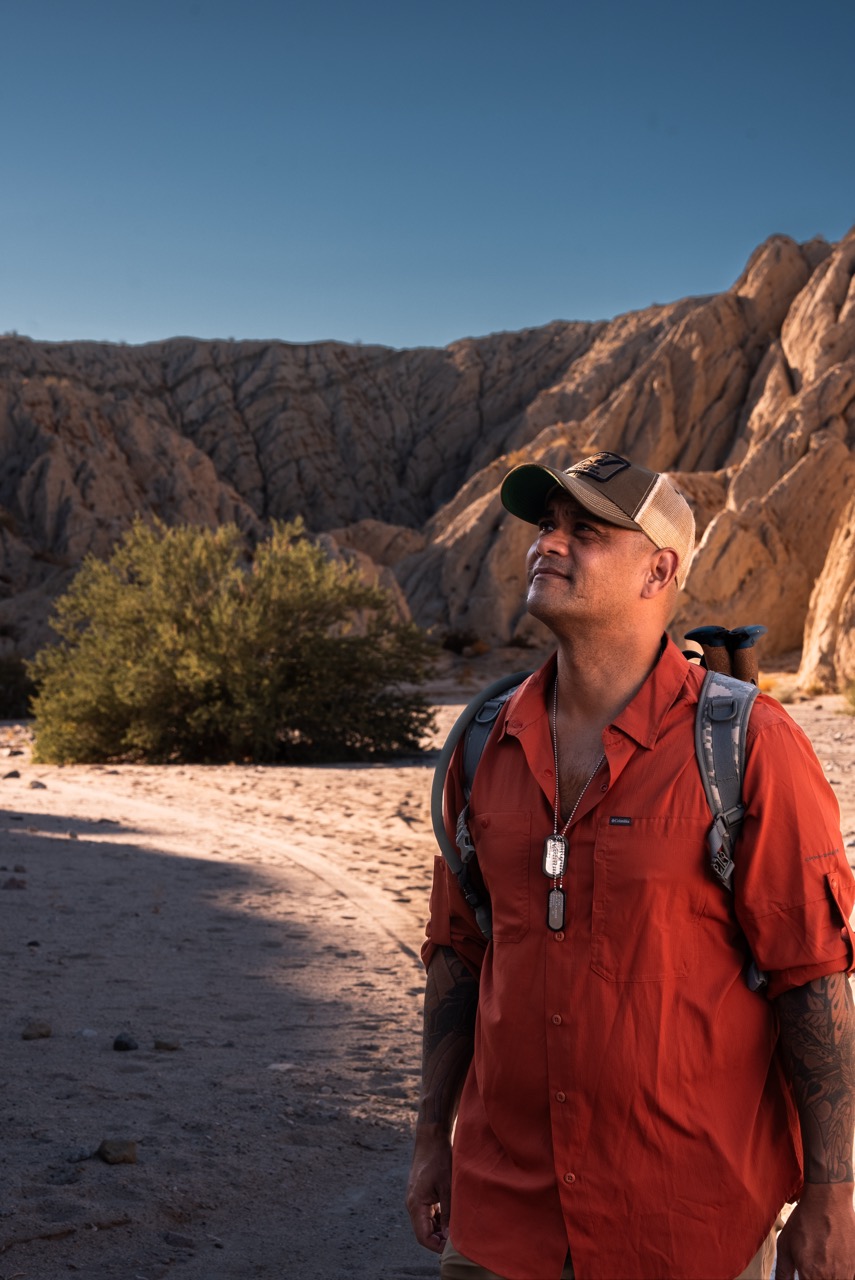
Craig Meling at Chuckwalla National Monument (Photo credit; Alex Hancook/Digital Nomad Video)
Craig Meling knew little about Chuckwalla when he and his husband bought a home in the Coachella Valley in 2021. Meling just knew he needed a change, and he needed help: After 18 years in the U.S. Army—including a deployment to Iraq, more than 250 combat missions, a Combat Action Badge, and a Bronze Star—the retired major had long struggled with PTSI symptoms that hindered his transition back to civilian life at home. That’s where the desert came in. “We came down here on a vacation, and we kind of fell in love with the mountains and the scenery,” Meling says. “It felt like a really special place for us.”
The mountains yielded more than scenery for Meling. They provided a source of nature-based healing that proved vital to his recovery from the trauma of war. He first encountered this phenomenon on a five-day retreat into the desert—no phone, no email, no distractions. He took in the colors of Box Canyon and contemplated the spiritual connection the land had long held for Indigenous Peoples before finally touching him. “For me, that was really the first time that I felt like I had gotten in touch with myself,” Meling says. “I felt what I would call a sense of peace. I hadn’t had the perspective of healing in nature and being right-sized in nature, if that makes sense.”
Meling’s experience of healing and restoration in the desert coincided with the growing coalition push to establish Chuckwalla National Monument. But conservation of the land wasn’t all Meling sought. As he observed in a March 2024 op-ed published in The Desert Sun, a monument designation would also preserve vital American military history: The proposed monument boundaries included Camp Young and Camp Coxcomb, former World War II training sites chosen for their similarity to desert conditions in Axis-controlled North Africa.
“It became really important for me to have the ability to connect with folks and share my experience with Chuckwalla,” Meling says. “There are other veterans coming home who still need this opportunity for healing, and the preservation of this land supports that. Speaking up for the monument was a patriotic duty that allowed me to continue my service in a different way.”
Meling’s conservation peers intersected in ways that both surprised him and proved crucial to expanding support for the Chuckwalla monument effort, from military veterans to the LGBT community and young conservationists he worked with around the Coachella Valley. He especially appreciated the opportunity to hear from members of the area’s Tribal Nations, whose original connection to the land still inspires him. “As an outsider, I don’t always get to directly hear their voices,” he says. “It’s been a very powerful opportunity for me.”