Summer 2025
By Stu VanAirsdale
Amid the mounting challenges to conserving nature nationally in 2025, the sturdiness and scope of the California Endangered Species Act (CESA) will be crucial to the long-term protection of native species and ecosystems here at home. CNPS Conservation Program Director Nick Jensen sat down with Flora to discuss the intricacies (and importance) of CESA, conservation successes and setbacks, and why this law is central to saving what matters most.
What is CESA, and why is it important in relation to California native plants?
CESA basically says that there are plants and animals that are worthy of increased protection due to their declining populations. So, when a development threatens a listed species’ habitat (and thus survival), the developer must go through the process of obtaining a special permit, called an Incidental Take Permit, that ensures any impacts are fully mitigated. This full mitigation standard is central to California’s biodiversity, ensuring that no project can cause a species to go extinct.
How does CESA define “fully mitigated”—and what else should “fully mitigated” include, in your opinion?
It means that the mitigation measures have to be proportionate to the impacts on the threatened or endangered species. The laws are set up to ensure that there are reasonable measures in place to compensate for loss—this may take the form of purchasing habitat that otherwise is threatened and could be developed or establishing new populations offsite. The applicant must ensure that there’s funding for the mitigation actions. This is all accomplished through the California Department of Fish and Wildlife. Before a developer is allowed to proceed with bulldozing, they need approvals from a county or a city. Then they have to receive a “take” permit from the state showing what they are doing in order to fully mitigate the loss. There’s no other place in the world of environmental review where a plant gets full mitigation. Absent CESA protection, a developer might say, “We’re going to plant in some plants in lieu of the plants that we’re taking out.” But the standard here is much higher because CDFW must ensure that the plan is likely to be effective.

Inyo rock daisy (Perityle emoryi) (Photo credit: Duncan Bell / CC BY-NC)
What are some of the state’s considerations when evaluating a CESA petition?
Any environmental threats, its biology, and how rare the plant actually is. Does the petitioner understand the plant’s natural constraints? What are the ecological factors or human factors that lead to endangerment or potential endangerment? This is on a population-by-population basis—you’re looking at every known group of the plant and saying, “We think this population could be threatened by development because…” CDFW staff does a formal report after that. It can take months or years to be officially listed, but a plant gets all of its protections once it’s determined to be a candidate.
It sounds like plants have, if not the same rights as animals, roughly proportionate considerations as animals.
Right. In general, you cannot jeopardize the existence of a species with a project. That’s part of CESA. And there are some plants listed under CESA that are known from one or very few populations in a concentrated location, whereby a single project could pose an existential risk to a species. That is the doomsday scenario that any conservationist wants to avoid. But CESA is set up for the Department of Fish and Wildlife to be able to make that determination. It is the strongest protection that we have for single organisms in California on private lands.

“California belongs to a global biodiversity hotspot, and most Californians take pride in the protection of our wildlife—including our remarkable plants.”

Bear Lake buckwheat (Eriogonum microthecum var. lacus-ursi) (Photo credit: Aaron Echols)
How does California’s Endangered Species Act relate to the federal Endangered Species Act?
That’s an especially important question right now. CESA actually predated the federal Endangered Species Act by three years. California has always understood the importance of this protection, and now that’s going to come into play more than ever. As we speak, the federal government has introduced a proposal that would change the definition of “harm” to listed species by excluding habitat destruction. Many plants and habitats would be affected by this change as habitat destruction of listed species occurs. For example, some endangered butterflies like the Quino checkerspot rely upon native plants as food sources—often our native plantains (Plantago spp.) in this case. With the proposed rule, a project that wipes out the host plant for this rare butterfly without actually killing the butterfly would now be allowed. Harmful changes like this mean that California’s strong protections for species and habitats are crucial now more than ever.
CESA has gone through changes over the years, most recently amended in 1997. How has its evolution and adaptations affected the conservation of native plants?
CESA was passed into law in 1970 and was originally limited to animal protection only. In 1984, it was amended to include plants and invertebrates. Then in 2018, Senate Bill 473 passed, giving CDFW the authority to develop its own non-regulatory recovery plans for listed species under the California Endangered Species Act. It’s not static—changes and legislation make it a stronger law or help do things for endangered species that are already listed. But it has stayed substantially the same for a long time.
Is it under attack from opponents in California government or in courts?
Not that I know of. Fortunately, in California, there’s legal gravitas associated with endangered species. From a societal perspective, it raises the level of importance when we are able to point to a formally listed species being under threat. California belongs to a global biodiversity hotspot, and most Californians take pride in the protection of our wildlife—including our remarkable plants.

The tiny Lake County western flax (Hesperolinon didymocarpum) is one of the California native plants most immediately threatened by planned development in its habitat. (Photo credit: Chloe and Trevor Van Loon / CC BY-NC)
How many species are added every year?
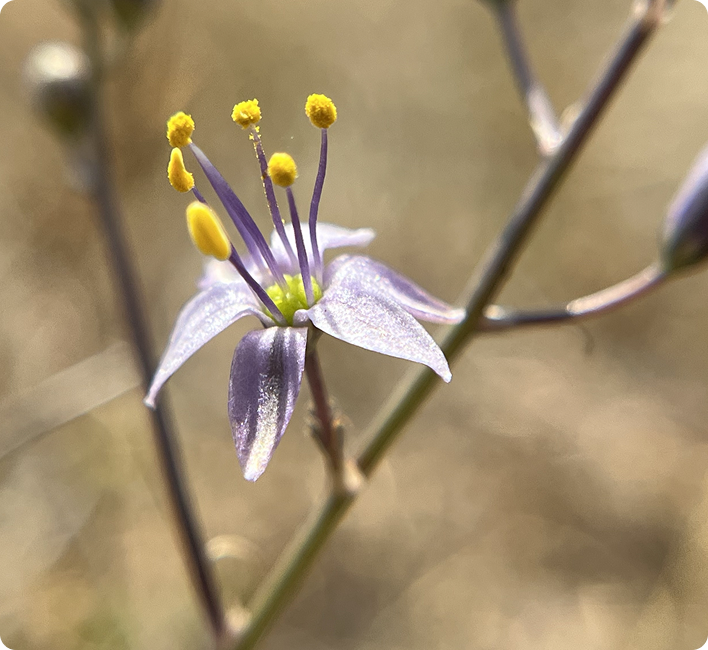
Very few; an average of less than one a year. In the past three or four years, there have been three: Lime Ridge eriastrum (Eriastrum ertterae), Inyo rock daisy (Perityle emoryi), and Shasta snow wreath (Neviusia cliftonii). Others are going through the petition process now, like Bear Lake buckwheat (Eriogonum microtheca var. lacus-ursi), Morro manzanita (Arctostaphylos morroensis), and Gerry’s curly-leaved monardella (Monardella sinuata subsp. gerryi). CNPS plans to petition additional high-priority species for listing under CESA. We estimate that there are hundreds of plants that warrant the protection afforded by CESA. There is a bit of a backlog, but we are committed to making significant progress toward closing this gap in the coming years.
What can CNPS do to help close that gap?
The simple answer is for individuals and organizations like CNPS to submit as many listing petitions as possible to CDFW for our rarest and most imperiled plants. By doing so, we will be able to chip away at the backlog. This also is an appeal to CNPS members and supporters to reach out to us if they might be interested in working on writing a listing petition. We need all hands on deck. Another important part of the equation is making sure that CDFW has enough staff to review submitted petitions. This involves outreach on the state budget to ensure that the state’s funding heads in the direction where it is needed most.
What do you think are perhaps most threatened—and thus perhaps the most important—plants on the list today?
Shasta snow wreath (Neviusia cliftonii) is important: It’s a plant that occurs on carbonate rock outcrops, many of which are adjacent to Lake Shasta. There have been proposals over the years to raise Shasta Dam, and if you raise Shasta Dam, you will raise the water level. Anything that’s in the increased bathtub ring gets flooded. Plants don’t like being flooded—they die. We also continue to advocate for Lake County western flax (Hesperolinon didymocarpum), which is actively threatened by the Guenoc Valley Project—a development that we’ve litigated on. There are scores of Lake County western flax that are going to need a take permit from CDFW. It is an example of a plant that is actively under threat. The most threatened plants on the list are those with small numbers of occurrences and active threats of development.

“I believe there is a sanctity in doing what we can to celebrate and conserve all of these components that make up biodiversity. We are a part of nature because we’re a species on this planet—nature is not for us.”

When you refer to a “dominant plant” in its habitat, what does that mean—particularly vis-à-vis a dominant plant going extinct?
Sometimes there are patches of chaparral habitat that are dominated by one or very few species. If something were to happen, and that plant was wiped out at that location, you wouldn’t just be wiping out a component of an otherwise diverse habitat. You’d wipe out most—or maybe even all—of the whole habitat. Some endangered species are actually indicative of habitat conditions. For example, a lot of our vernal pool grasses—the Orcuttia genus, the Tuctoria genus—live in a particular type of vernal pool with periods of long inundation, deeper pools, or other characteristics that support these rare vulnerable grasses. If you modify those vernal pools such that those grasses no longer exist, you’re likely to lose a lot of the other things that are supported, including a bunch of rare animals, too.
And vernal pools have long been under threat in California, right?
Yes, and it’s just continuing on. They’ve lost a lot of ground.
How can we apply CESA and other laws to defending vernal pools and other sensitive habitats—their plant and animal species—from extinction?
This is critically important, since we already lost so much before these protections were in place. For example, California is estimated to have lost 90% of wetlands and more than 80% of the old growth mixed conifer forest in the Sierra Nevada has vanished in the past 150 years or so. We can provide public comment on projects through the environmental review process, with the hope that most cities and counties and permitting agencies favor development that avoids direct impacts to these very special habitats. Unfortunately, those impacts continue—though maybe not at the same pace as in the past.
I think some of the best things that happen for the conservation of endangered species are things that we never hear about—things that are noted in a project’s EIR (environmental impact review), for example. A developer might learn they have a vernal pool on their property with listed plants or listed animals. If I’m a smart developer, I’m going to say, “Let’s maybe shift the road this way,” or, “We’re not going to touch this area.” I have to believe that some of the most important moments with the California Endangered Species Act happen at the desktop-review level, where a developer says, “I don’t want to interfere with that listed grass or that listed animal. We’re going to do everything we can to site our project in a way that avoids those impacts.” When CNPS goes in and looks at the planning documents, you don’t see the impacts to the listed species because they’ve pre-avoided those.
Let me play devil’s advocate: Why does it matter if any of these plants go extinct? Is there some social or ecological benefit to protecting them?
It’s a good question: Does the world end if the Shasta snow wreath goes extinct, or if any of these species go extinct? Probably not. Will the ecosystems that they’re a part of collapse? Probably not. However, some of them—particularly some of the manzanitas—are the dominant plant in their habitat. As long as the process of evolution is allowed to continue, and as long as there’s changing habitat, such as it is, life essentially goes on. But most of us believe that it’s a tragedy, and that it’s a moral imperative that humans should not be allowed to cause another species to go extinct.

Morro manzanita (Arctostaphylos morroensis) is among the native plant species currently under consideration for listing under the California Endangered Species Act. (Photo credit: Logan Lehigh / CC BY-NA)
Let’s also remember that plants provide food, medicine, and ecosystem services like erosion control and water filtration. We are discovering new benefits and uses all the time. However, those utilitarian arguments are only part of the equation. I believe there is a sanctity in doing what we can to celebrate and conserve all of these components that make up biodiversity. We don’t want a world that is just turf grass of a single species, right? We are a part of nature because we’re a species on this planet—nature is not for us. And it’s certainly not for us to make a decision that we can just be without one of these precious current iterations of the evolutionary process.
So, amid all the policies and laws, conservation really just comes down to a choice, right?
Exactly. Humans can nurture or destroy things. That is a choice. It would be nice if there weren’t threats to nature and there was no need for conservation action. I would love to live in that world. But that’s not the world we live in. There are pressures on the natural environment. If a piece of habitat has been protected, or if a species has been protected, or if there has been some sort of innovative conservation action that has resulted in something good happening for the environment, that has been the active decision of people or a group of people. We aren’t just the problem; we can also be the solution.